




By: Ade Sofatullah & Hayati Nupus
(Law Student & Law English Lecturers) Faculty of Law, Pamulang University
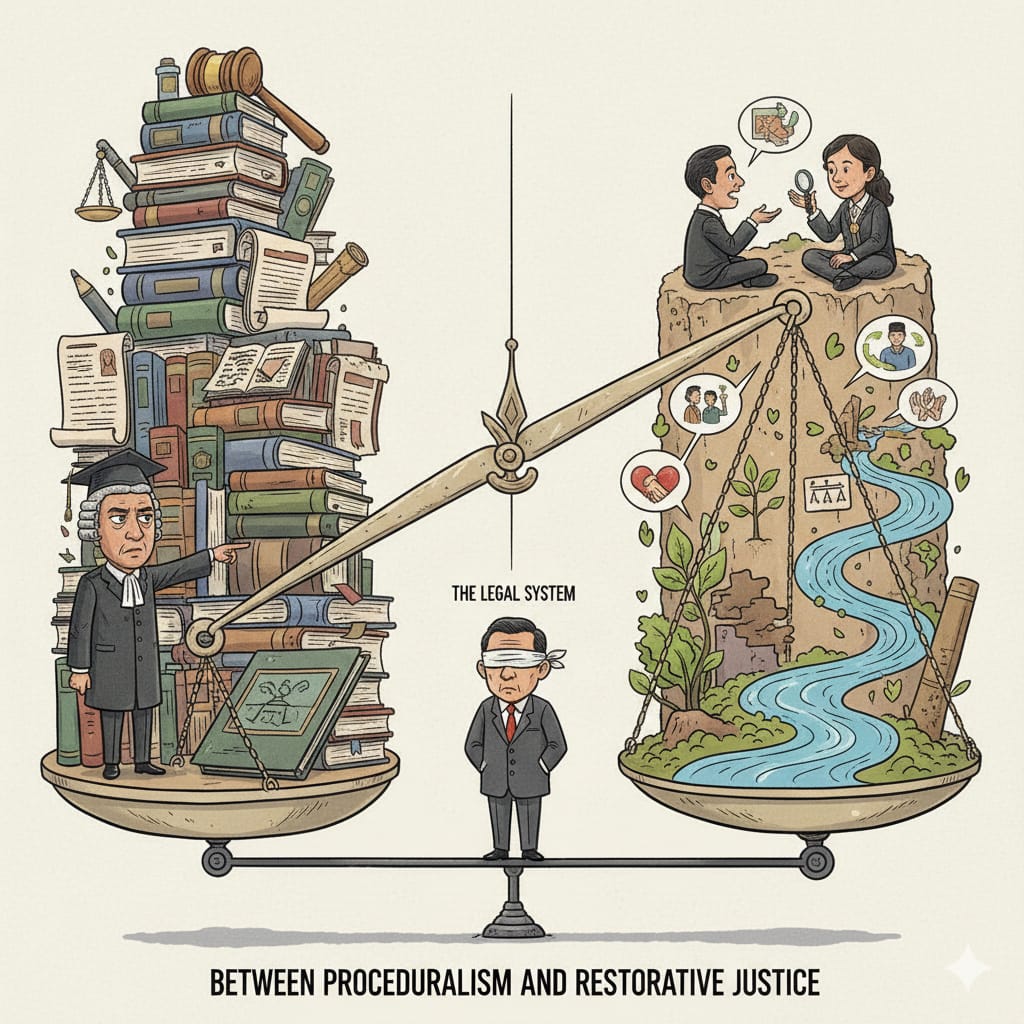
[BANTENESIA.NET], KOTA SERANG – In contemporary Indonesian criminal law discourse, the termination of criminal investigations can no longer be viewed merely as an administrative mechanism to end cases that “fail to grow.” Instead, it reflects a broader paradigm shift in law enforcement—one that increasingly balances procedural certainty with substantive justice.
Traditionally, the authority to terminate investigations is governed strictly by Article 109 paragraph (2) of the Indonesian Criminal Procedure Code (KUHAP).
This provision allows investigators to issue an order to terminate an investigation (SP3) only under limited and imperative conditions: insufficient evidence, the absence of a criminal act, or termination by operation of law.
From a technical-juridical perspective, this framework embodies the principle of legality and seeks to prevent arbitrary use of discretion.
However, in practice, the application of Article 109(2) has raised persistent concerns. The ground of “insufficient evidence,” for instance, often becomes a gray area, inviting questions regarding investigators’ objectivity in assessing whether the minimum evidentiary threshold has been met. Even more complex is the determination that an act does not constitute a criminal offense, particularly in cases involving the criminalization of civil disputes.
Here, investigators must carefully distinguish between malum in se—acts inherently wrongful—and matters that properly belong to the realm of civil law.
A significant development in this context is the emergence of Restorative Justice (RJ) as a basis for terminating investigations. The issuance of Police Regulation No. 8 of 2021 and Prosecutorial Regulation No. 15 of 2020 marks a shift toward a more humanistic approach to criminal justice.
These regulations allow certain cases to be resolved through restorative mechanisms, emphasizing reconciliation, victim recovery, and social harmony rather than retribution.
From a theoretical standpoint, this development reflects the exercise of discretionary power (diskresi) by law enforcement authorities, as well as the doctrine of dominus litis.
Yet, it also raises a fundamental juridical question: can internal regulations legitimately expand grounds for termination beyond those explicitly provided by the Criminal Procedure Code? Critics argue that such practices risk undermining the principle of legality if not carefully controlled within a clear hierarchical framework of laws.
Restorative Justice, however, is not applied arbitrarily. Both police and prosecutorial regulations impose strict material and formal requirements.
RJ may only be applied to cases that do not threaten public order, national unity, or state security, and that do not involve recidivism, corruption, narcotics trafficking, or serious crimes. Additionally, it requires voluntary reconciliation between the parties and the fulfillment of victims’ rights.
When properly implemented, RJ serves broader policy objectives, including reducing prison overcrowding and promoting swift, simple, and low-cost justice.
Nonetheless, the risk of abuse remains. Without adequate safeguards, restorative mechanisms may be vulnerable to the “commercialization of peace,” where financial settlements overshadow genuine accountability. To mitigate this risk, the mechanism of a special case review (gelar perkara khusus) becomes essential.
This process functions as an internal check and balance before a termination decision is finalized. Externally, judicial review through pretrial proceedings and public oversight by institutions such as the Ombudsman and the National Police Commission remain crucial.
In conclusion, the termination of criminal investigations today is no longer merely an emergency exit for weak cases. It has evolved into a legal instrument aimed at achieving substantive justice through restorative approaches.
The challenge for law enforcement lies in ensuring that discretion does not become a loophole for inequality before the law. Law must not remain a lifeless text; it must live within society, capable of healing social wounds without sacrificing legal certainty. ***